
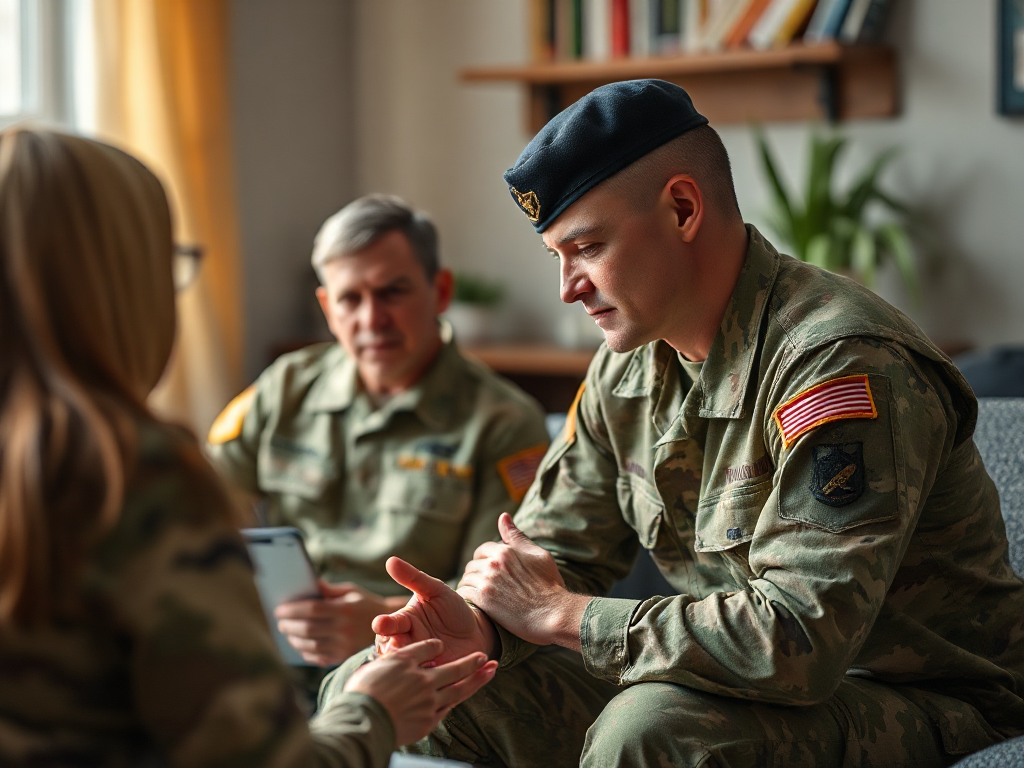
PTSD-related dissociation during conversations about military service can make a person feel detached, lose track of the discussion, or experience a blank period when reminders activate the brain’s threat response. Military language, names, locations, sensory details, guilt, and questions that resemble an after-action review may intensify that reaction. A safer response is to pause the conversation, name the present date and location, use sensory grounding, reduce questioning, and agree on a way to resume later. Repeated episodes, dangerous lapses in awareness, severe distress, substance use, or thoughts of self-harm warrant prompt evaluation by a qualified mental-health professional or crisis service.
How Military-Service Conversations Can Trigger Dissociation
Conversations about military service can activate dissociation when words, questions, sounds, or interpersonal dynamics resemble aspects of a traumatic experience. The trigger may be obvious, such as discussing a deployment, combat exposure, injury, or loss. It may also be indirect: a demand for details, a particular rank or unit reference, the smell of fuel, a television report, or the feeling of being evaluated by someone who wants a complete account.
Dissociation is not simply distraction or unwillingness to talk. It may involve a disruption in awareness, memory, identity, perception, or a sense of connection with the present. During a difficult discussion, a person may mentally retreat, feel unreal, hear the speaker as if from far away, or continue answering without fully registering the exchange. PTSD-related dissociation is a clinical symptom pattern, not a character flaw and not proof that someone is hiding information.
The nervous system may treat a present-day conversation as a signal of immediate danger. Attention then narrows toward survival cues rather than ordinary social processing. A question such as “What happened next?” can feel neutral to the listener but resemble interrogation, debriefing, or forced recall to the person being asked. Pressing for a coherent timeline may increase detachment rather than produce better memory.
Consider two different approaches. A friend who asks for a detailed account and keeps correcting dates may intend to help but can unintentionally increase pressure. A friend who asks whether the person wants to continue, offers a pause, and accepts uncertainty reduces the demand on memory and control. The second approach does not avoid the subject permanently; it creates conditions in which the person can remain oriented enough to choose what to share.
Readers seeking broader information can also review PTSD-related dissociation during conversations about military service alongside professional resources. The practical priority is not extracting the full story in one sitting. It is recognizing activation early, protecting present-moment safety, and preserving the speaker’s ability to stop.
What Dissociation Looks Like During a Conversation
Dissociation may be subtle, so conversation partners often mistake it for rudeness, intoxication, fatigue, or deliberate avoidance. A person might stare at one point, pause unusually long, lose the thread of a sentence, repeat a phrase, speak in a flat tone, or appear to answer automatically. Some people notice a sudden sense of distance from their body or surroundings. Others recognize the episode only later, when they realize they cannot recall several minutes.
Observable behavior alone cannot establish a diagnosis. Similar signs can occur with panic, sleep deprivation, medication effects, traumatic brain injury, seizure disorders, substance use, depression, or other medical and psychological conditions. That distinction matters because a conversation partner should respond to the immediate safety issue without declaring, “You are dissociating,” as though making a clinical determination.
A useful observation is a change from the person’s normal conversational pattern. For example, a veteran may be discussing a routine administrative matter and then become unable to track simple questions after a reference to a convoy route or casualty report. The change may be followed by confusion, headache, exhaustion, shame, or a strong urge to leave. Recording the context, approximate duration, visible signs, and recovery afterward can help a clinician assess patterns without requiring the person to retell traumatic details repeatedly.
A common mistake is treating eye contact as a test of honesty or awareness. Someone who looks away may be trying to manage sensory overload; someone who maintains a fixed stare may be less connected to the exchange than they appear. Another mistake is asking rapid orientation questions in an accusatory tone. Short, calm prompts are more useful: “Can you tell me your name?” “Are you here with me?” and “Would you like more space?” If the person cannot answer, reduce demands and check for immediate danger.
Use a private note to distinguish possible warning signs from assumptions. Useful details include the topic being discussed, the setting, the presence of noise or crowds, whether the person remained able to make safe decisions, and how long recovery took. Avoid recording graphic content or circulating personal information. Documentation should support care, not become another form of scrutiny.
Grounding and Conversation-Pacing Methods
Grounding during a military-service conversation works best when it restores orientation without turning the moment into an examination. Pause the subject, lower the pace, and speak in ordinary present-tense language. A person may benefit from feeling both feet on the floor, identifying several neutral objects in the room, holding a cool drink, or noticing the difference between the current chair and a remembered vehicle or field setting.
Ask permission before touching the person or moving closer. Physical contact can be comforting for one person and threatening for another, especially when the discussion involves restraint, assault, medical treatment, or combat. Avoid blocking the exit. A quiet location may help, but do not assume isolation is always safer; some people regulate better when a trusted support person is nearby.
A compact response sequence can keep the conversation manageable:
- Pause: Stop asking for details and state that the conversation can wait.
- Orient: Name the current place, approximate time, and relationship of the people present.
- Offer choice: Ask whether the person wants silence, water, a different room, or a trusted contact.
- Check safety: Determine whether they can travel safely, care for themselves, and avoid driving if awareness remains impaired.
- Plan a later discussion: Agree on a time limit, a stop phrase, and a less activating setting if the topic must be revisited.
Grounding is not a guarantee that an episode will end immediately. It may reduce escalation or help the person reconnect enough to make a safe choice. Trying ten techniques in quick succession can feel like pressure. Select one or two familiar options, watch for signs of increasing distress, and stop if the method makes the person more frightened or disoriented.
The conversation itself may need redesign. Open-ended prompts such as “Tell me everything” create a large memory and emotional burden. A narrower invitation—“Would it help to discuss only what you need for today’s appointment?”—allows control over scope. Written communication may be easier than speaking, while some people find written questions more threatening because they feel permanent. The appropriate format depends on the person, the setting, and whether immediate decisions are required.
Signs that the approach is helping include more coordinated speech, awareness of surroundings, the ability to choose between options, and a gradual return of ordinary emotional range. Signs it is failing include worsening confusion, frantic escape behavior, inability to stay safe, escalating anger, fainting, or new medical symptoms. At that point, prioritize safety and professional assistance over completing the discussion. Related planning can be reviewed through PTSD-related dissociation during conversations about military service.
Professional Support, Safety, and Next Steps
Recurring dissociation during conversations about military service deserves clinical attention, particularly when it disrupts work, relationships, medical appointments, driving, parenting, sleep, or treatment participation. A licensed mental-health professional can assess PTSD symptoms, dissociation, panic, depression, substance use, traumatic brain injury history, medications, and medical explanations. Assessment does not require an immediate detailed disclosure of every traumatic event.
Bring practical observations rather than forcing a polished narrative. A brief record might state: “During a discussion about a deployment location, awareness seemed reduced for about five minutes; afterward there was confusion and exhaustion.” Include known triggers, early warning signs, what reduced distress, and what made it worse. If memory gaps are present, say so plainly. A clinician may use that information to discuss treatment options and pacing.
Trauma-focused treatment can involve careful preparation, stabilization, and gradual work with traumatic memories, but the exact approach should be individualized. A person who becomes detached quickly may need stronger present-focused skills and a slower pace before intensive recall work is considered. Avoid self-directed exposure, forced retelling, or online exercises that encourage vivid re-creation without professional support. The goal is not to produce the most complete account; it is to improve safety, functioning, and informed control.
Supporters also need boundaries. A spouse, friend, or coworker can pause a conversation and help arrange care, but should not act as a therapist, investigator, or sole crisis plan. Confidentiality matters, especially when military experiences involve other people. Do not share details with family members, supervisors, or online groups without permission unless there is an immediate safety emergency.
Seek urgent help if the person is at immediate risk of self-harm or harming someone else, cannot remain oriented enough to stay safe, has severe medical symptoms, or may be intoxicated or experiencing a neurological emergency. In the United States, call or text 988 for crisis support; call emergency services when there is immediate danger. Veterans can also contact the Veterans Crisis Line by dialing 988 and pressing 1. Outside the United States, use the local emergency or crisis service.
A useful next step is to create a conversation agreement before discussing service history: identify acceptable topics, a stop signal, preferred grounding cues, who may be contacted, and what happens if awareness drops. Such an agreement is not avoidance. It is a practical safeguard that makes future communication more predictable and gives the person a meaningful route back to the present.
Frequently Asked Questions
Can talking about military service cause dissociation?
It can activate dissociation when the conversation resembles a traumatic situation or includes reminders such as locations, sounds, guilt, or pressure to provide details. The topic itself is not equally triggering for everyone.
How should I respond if someone seems detached while describing service?
Stop requesting details, use a calm voice, offer space, and ask brief present-focused questions. Do not touch them without permission or treat the episode as evidence of dishonesty.
Should a person be encouraged to remember everything?
No. Forced recall can increase distress and detachment. A qualified clinician can decide how much memory work is appropriate and how to build stabilization skills first.
When does dissociation require professional evaluation?
Evaluation is appropriate when episodes recur, cause memory gaps, interfere with daily life, follow medication or substance changes, or create safety concerns such as impaired driving or inability to care for oneself.
Can grounding prevent every dissociative episode?
No. Grounding may help some people reconnect with the present or limit escalation, but results vary. A clinician can help identify suitable techniques and address the underlying PTSD pattern.
Conclusion
Dissociation during a conversation about military service should be treated as a possible stress response and a safety signal, not as a failure of character or proof that a person is withholding information. The most useful response is to reduce questioning, restore present-moment orientation, offer choices, and avoid touch or confrontation unless safety requires immediate action. Repeated episodes, significant memory gaps, medical concerns, or disruption to daily life call for assessment by a qualified professional. Before revisiting service history, agree on limits, a pause signal, grounding preferences, and a plan for obtaining help. These safeguards make difficult conversations more controlled without demanding that the person disclose traumatic details before they are ready.