
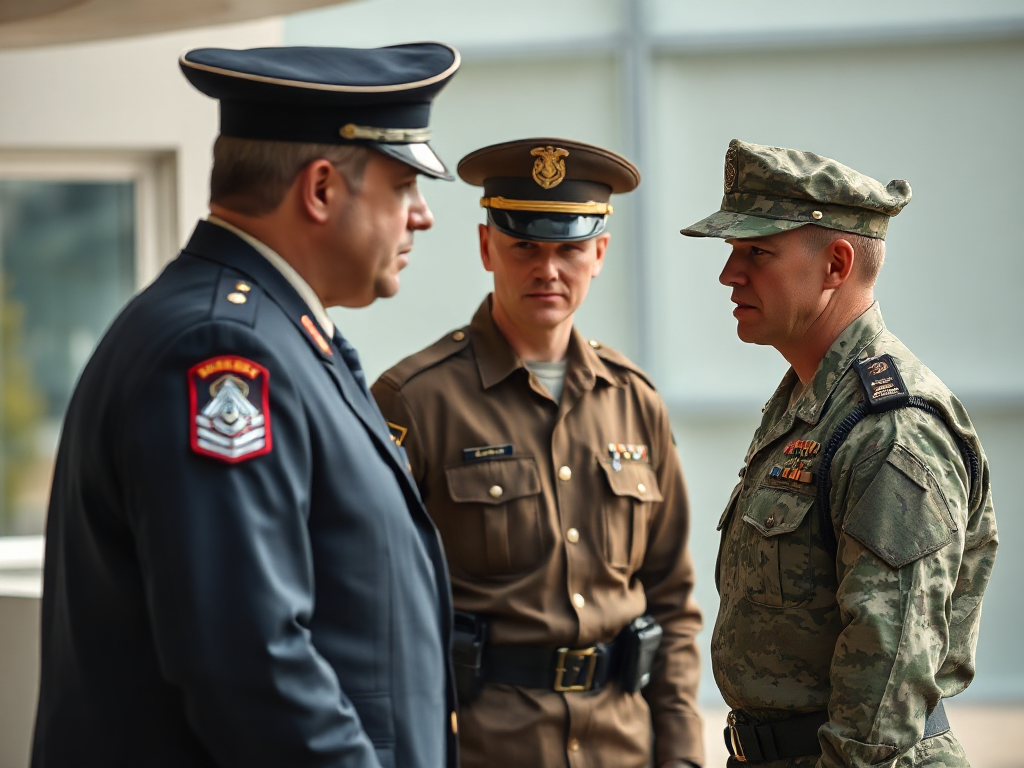
Handling uniformed authority figures after traumatic military experiences is safer when you prepare a brief exit plan, identify body-based warning signs, and use grounding before deciding how much contact to continue. Uniforms, commands, radios, vehicle lights, or formal questioning may activate learned threat responses even when the present person is not dangerous. Move toward a public or staffed area, create physical space, state a short boundary such as “I need a moment,” and contact a trusted person when possible. Avoid forcing prolonged eye contact or explaining your history while overwhelmed; trauma-informed therapy can help build tolerance without treating every uniformed encounter as an emergency.
Why Uniformed Encounters Can Feel Immediately Dangerous
Uniformed authority figures can trigger a rapid threat response because the brain links present-day cues with earlier experiences, not because the person has made a conscious decision to overreact. A police officer, security guard, corrections officer, military official, or emergency responder may share visual and behavioral signals with people, places, or commands associated with danger. Boots, insignia, a clipped tone, a radio transmission, a vehicle light, or a request to show identification can be enough to produce tension, anger, numbness, rapid breathing, or an urge to leave.
The reaction may involve more than fear. Some people become highly alert and compliant, while others freeze, argue, dissociate, or feel trapped by the expectation that an authority figure must be obeyed immediately. The body may respond before the person has assessed whether the current encounter is safe. That timing matters: trying to debate the reaction while the nervous system is already activated often adds shame and makes clear thinking harder.
A useful distinction is the difference between present danger and trauma activation. They can occur together, so neither should be dismissed. Look for current facts: Is the person threatening you, blocking your movement, reaching for a weapon, escalating the interaction, or directing you into an isolated space? If so, prioritize immediate safety and local emergency assistance. If the encounter is controlled and the distress rises mainly from the uniform, voice, or posture, grounding and distance may give you time to evaluate rather than react automatically.
For example, a former service member stopped at a government building may feel compelled to stand rigidly and answer every question despite becoming lightheaded. Another person may interpret a routine security check as an impending confrontation and leave abruptly. Neither response proves that the encounter is unsafe, and neither should be treated as a character flaw. The practical objective is to insert a small decision-making interval between the cue and the next action. Readers researching handling uniformed authority figures after traumatic military experiences should treat that interval as a safety tool, not a demand to appear calm.
A Grounding Plan for the First Minute
The first minute is best used to stabilize attention, breathing, posture, and location rather than to explain the entire military history behind the reaction. A compact plan works better under stress than a long script. Notice both feet on the ground, identify the current date and location, loosen the jaw, and breathe out slightly longer than you breathe in if that feels comfortable. These actions do not erase a memory; they provide present-time information that may reduce automatic escalation.
Position matters as much as internal calming. If possible, stand or sit where you can see an exit, keep a comfortable distance, and remain near other people or staff. Avoid backing into a confined corner simply because an authority figure has approached. A public setting can offer witnesses and practical assistance, while a trusted companion can handle part of the conversation if you have planned that role in advance.
A simple first-minute sequence may look like this:
- Orient: silently name where you are, who is present, and what is happening now.
- Regulate: press your feet into the floor, release unnecessary muscle tension, and use a slow exhale.
- Choose: decide whether to continue, request a pause, move toward support, or leave when leaving is lawful and safe.
- Communicate: use one short sentence rather than a detailed account while overwhelmed.
Concrete sensory details can be more reliable than instructions to “calm down.” You might notice the texture of a chair, name five neutral objects, or hold a cool drink. If counting or controlled breathing makes you feel more trapped, use orientation and movement instead. The right technique is the one that increases contact with the present; a method that intensifies dizziness, panic, or dissociation should be stopped.
Common mistakes include staring at the uniform to prove it is harmless, forcing yourself to remain in the interaction as a test of strength, or using alcohol or sedating substances before an anticipated encounter. Those choices can impair judgment and make communication less predictable. A grounding plan should preserve options, not create a new safety risk. Practice it first in ordinary public situations, then adjust it based on signs that it actually improves orientation and choice.
Boundaries, Communication, and Physical Safety
Short, respectful communication can protect both safety and dignity when a uniformed authority figure asks questions. You do not need to disclose combat history, a diagnosis, or personal details to justify needing a pause. A prepared phrase such as “I am having a stress reaction and need a moment to understand the question” may be enough. Other options include “Please speak one question at a time,” “I can respond more clearly if we move to a public area,” or “I need to contact my support person.”
The appropriate response depends on the authority involved and the situation. A private security guard, police officer, probation officer, military official, and emergency responder do not have identical powers or procedures. Do not assume that a boundary statement cancels a lawful instruction, and do not assume that compliance requires surrendering every personal boundary. If legal consequences, detention, custody, or a formal investigation are possible, request legal advice rather than improvising from trauma memories or online claims.
Communication often deteriorates when the person tries to prove that the authority figure resembles someone from the past. That comparison may be emotionally accurate but rarely clarifies the immediate interaction. Focus on observable needs: time, space, repetition, a support person, or a move to a less crowded location. If speech becomes difficult, a written card or phone note can state your preferred contact person and the basic request. Keep it factual and avoid carrying sensitive medical information unless there is a clear reason to share it.
Consider a traffic stop or building screening. Raising your voice, making sudden movements, or reaching quickly for a phone may be interpreted as escalation even when the intent is self-protection. A safer approach may be to keep hands visible, narrate a slow movement when appropriate, answer only what is required, and ask for clarification. That does not guarantee a favorable interaction; it reduces avoidable ambiguity while you assess the conduct of the other person.
Signs that the interaction is becoming less safe include threats, insults, deliberate crowding, refusal to let you contact assistance when you are entitled to do so, or instructions that move you away from visible support without a clear reason. At that point, grounding alone is not the priority. Move toward safety when possible, seek witnesses, follow emergency procedures, and document what happened afterward while details remain available.
Building Tolerance Without Forcing Exposure
Long-term improvement usually comes from carefully chosen practice, not from repeatedly forcing yourself into the most intense uniformed encounter. A trauma-informed clinician can help separate manageable discomfort from destabilization and can adjust the pace. The aim is not to like uniforms or to suppress justified caution. It is to increase the ability to notice present conditions, choose a response, and recover afterward.
A graded approach might begin with discussing the trigger in a safe setting, then viewing a neutral image briefly, visiting a public place where uniforms may be present with an easy exit, or role-playing a routine question with a trusted person. Each step should have a clear stopping point and a recovery plan. Moving too quickly can reinforce the belief that the cue is uncontrollable; avoiding every setting can preserve the belief that contact is impossible. The useful middle ground is planned practice within a tolerable range.
Readiness is not measured only by whether anxiety appears. Notice whether you can remain oriented, remember what was said, use a boundary, and return to baseline after leaving. A practice attempt may need to be scaled back if it produces prolonged dissociation, unsafe driving, severe sleep disruption, or urges to use substances. Those signs are not evidence of failure; they indicate that the task, timing, support, or therapeutic preparation needs revision.
For example, someone who can tolerate a uniformed cashier at a store may not be ready for a police-station lobby or a military ceremony. Treating those settings as equivalent creates an unrealistic comparison. A better plan identifies the exact cue: command voice, official paperwork, physical proximity, insignia, or uncertainty about authority. Practice can then target one element while preserving control over duration and exit.
Do not use exposure as a private test of whether you are “over” trauma. The method is not appropriate for every person or every period of instability, and professional guidance may be especially useful when there is active substance misuse, self-harm risk, severe dissociation, or an unsafe home environment. Handling uniformed authority figures after traumatic military experiences becomes more workable when progress is defined by flexible choices and recovery, not by forced endurance.
When Professional Support Should Be Part of the Plan
Professional support deserves priority when uniformed encounters interfere with medical care, employment, housing, legal obligations, transportation, or ordinary public activities. A licensed mental health professional familiar with trauma can assess whether the reaction fits a trauma-related pattern, anxiety, panic, dissociation, depression, or another concern. An article cannot diagnose the cause, and self-labeling can obscure conditions that need different care.
Bring specific examples to an appointment: what cue appeared, what your body did first, what you thought might happen, how long the reaction lasted, what you did next, and what helped or worsened it. This information is more useful than a general statement that uniforms are difficult. Ask about treatment options, pacing, privacy, crisis planning, and how to handle unavoidable official contact while care is underway. If a provider treats forced confrontation as the only valid approach, ask how safety, consent, and stabilization will be addressed.
Support can also be practical. A trusted person may accompany you, wait nearby, help rehearse a script, or record important details afterward. Choose someone who will not speak over you, challenge your account, or pressure you to remain in an interaction. If an organization offers a disability, veteran, patient, or victim-support contact, ask what assistance it can actually provide before relying on it.
Urgent help is warranted when a reaction includes thoughts of suicide or harming someone, inability to stay oriented, dangerous driving, or fear that you may act impulsively. Contact local emergency services or a crisis service appropriate to your location. If the uniform itself is a crisis cue, ask a trusted person to make the call or identify non-uniformed crisis options where available. Immediate safety takes precedence over explaining the history perfectly.
A common misconception is that seeking help proves weakness or disloyalty. Another is that a diagnosis automatically explains every difficult interaction. Neither assumption is useful. Good care preserves legitimate situational awareness while reducing the chance that an old threat pattern controls present choices. Keep a brief written plan in your phone, review it with a clinician or trusted person, and update it after real encounters rather than waiting for a major crisis.
Frequently Asked Questions
Why can a uniform trigger a reaction even when the person is helpful?
The nervous system may connect the uniform, posture, voice, or command style with earlier danger. That learned association can activate before the present person’s intentions are fully assessed.
What should I say if I become overwhelmed?
Use a short, factual request such as “I need a moment,” “Please repeat that slowly,” or “I need to contact my support person.” Detailed trauma disclosure is not required.
Should I avoid all contact with uniformed authority figures?
Avoiding genuinely unsafe situations is appropriate, but total avoidance may make unavoidable encounters harder. A clinician can help distinguish sensible safety planning from avoidance that restricts necessary activities.
Can a friend come with me to an official appointment?
Often a trusted person can provide practical support, although access rules vary by agency and setting. Confirm permission ahead of time and decide what role the person will take.
When should I seek urgent help?
Seek urgent assistance for suicidal thoughts, threats toward others, severe disorientation, dangerous impulsivity, or inability to remain physically safe. Use local emergency or crisis resources and involve a trusted person when possible.
Conclusion
Uniformed encounters become more manageable when the plan addresses both present safety and trauma activation. Before an anticipated interaction, identify an exit, a support contact, a short boundary statement, and the grounding method that keeps you oriented. During the encounter, assess observable behavior rather than assuming either danger or harmlessness from the uniform alone. Keep hands and movements predictable where appropriate, ask for clarification, and seek immediate safety if the person becomes threatening or the setting becomes isolated. For recurring disruption, professional trauma care can help you practice specific cues at a tolerable pace without treating forced exposure as the measure of recovery. Review what happened afterward, note what improved or failed, and revise the plan for the next unavoidable contact.