
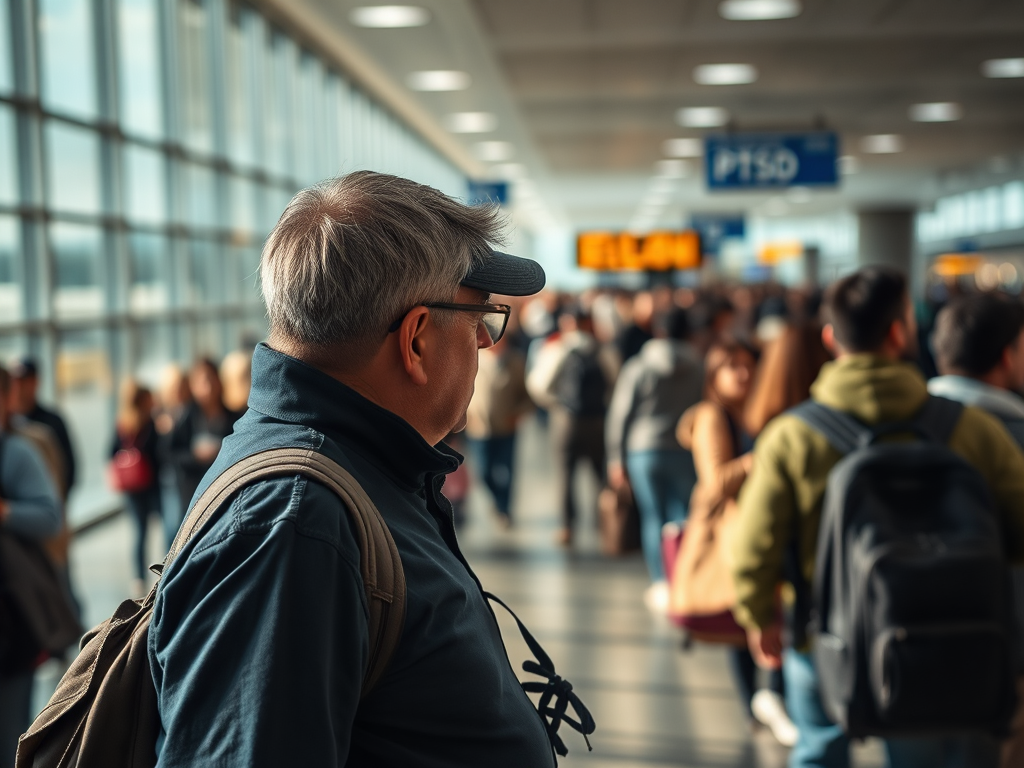
When PTSD makes crowded airports especially difficult for former service members, dense crowds, unpredictable movement, security procedures, and limited control over personal space can activate threat responses linked to earlier trauma. Advance planning can reduce strain by choosing quieter travel times, building extra time into each airport stage, identifying exits and calm areas, and arranging assistance when available. Noise-canceling headphones, a trusted travel companion, prescribed medication used only as directed, and a preplanned response to rising symptoms may make the environment more manageable. Avoiding airports entirely is not the only option, but forcing exposure without support can intensify distress and make future travel harder.
Why Airport Crowds Can Activate PTSD Responses
Crowded airports can place several stressors together: close physical proximity, loud announcements, unfamiliar people moving quickly, confusing signs, screening procedures, and pressure to reach a gate by a fixed time. For a former service member with PTSD, that combination may be interpreted by the nervous system as a threat even when the airport is objectively safe. The reaction is not a character flaw or proof that someone is unwilling to travel; it can reflect conditioned alarm, heightened scanning for danger, and reduced tolerance for uncertainty.
Military experiences can also shape which airport details feel threatening. A crowded terminal may create a sense of restricted movement, while a person approaching from behind, a sudden shout, or an unexpected change at a checkpoint may produce an immediate startle response. Someone who normally manages symptoms in familiar settings may become overwhelmed when sleep loss, jet lag, pain, or accumulated anticipation reduces their capacity.
Consider two different responses to the same terminal. One traveler becomes watchful and repeatedly checks the surroundings; another feels trapped, dissociates, or needs to leave the line. Both may be responding to the same loss of control, but the useful intervention differs. Scanning may call for grounding and a clear route to the gate, while dissociation may require a companion, a seated pause, and professional guidance if it persists.
A common mistake is treating every difficult airport experience as a test of willpower. Pushing through severe symptoms without a plan can increase panic and reinforce the belief that airports are impossible. A better goal is controlled participation: identify the pressure points, reduce avoidable demands, and preserve choices where possible. Resources about when PTSD makes crowded airports especially difficult for former service members should be applied to the person’s actual symptoms rather than to a generic travel checklist.
The Airport Pressure Points to Anticipate
Security screening is often difficult because it combines waiting, instructions, personal-space changes, and the possibility of being redirected. The terminal may add a second challenge: movement is unpredictable, yet the traveler must remain alert to announcements and gate changes. Boarding can bring another form of confinement, especially when passengers queue closely or when a delay leaves people standing in a narrow area.
Timing matters because arriving too late creates urgency, but arriving extremely early can mean spending hours in a stimulating terminal. The most useful arrival window depends on airport size, the need for accessible assistance, checked baggage, mobility concerns, and the traveler’s past reactions. A short, familiar airport visit at a quiet hour may be easier than a long wait during a peak departure period. Extra time should create flexibility, not an unnecessarily prolonged exposure.
Before travel, write down the parts most likely to cause trouble. A person may tolerate the concourse but struggle with the security line, or manage security but become distressed when a gate changes. This distinction prevents overplanning for every possible problem while missing the actual trigger. If a previous trip ended with an abrupt exit from the terminal, examine what happened immediately beforehand: missed sleep, a crowded queue, a loud alarm, an argument, a surprise pat-down, or uncertainty about where to go.
- Check the terminal layout, restrooms, elevators, exits, and quieter seating areas.
- Confirm baggage, identification, medication, and transportation details before leaving home.
- Decide who will speak with staff if symptoms make communication difficult.
- Choose a meeting point in case the traveler and companion become separated.
The weak assumption is that a familiar airport will always feel manageable. Construction, staffing, delays, or a different security lane can change the sensory load. Treat the plan as adaptable rather than guaranteed. A printed itinerary and an offline phone note may be useful if stress makes digital searching difficult.
A Practical Plan for Travel Day
A workable airport plan divides the trip into small transitions: leaving home, reaching the terminal, checking baggage, passing screening, finding the gate, boarding, and handling a delay. Each transition should have a next action and a fallback. For example, after screening the traveler might go directly to a preselected seating area, drink water, and check the gate once rather than repeatedly scanning every display.
Grounding should be practiced before travel, not invented in the middle of a crowded line. Slow breathing, naming visible objects, feeling both feet on the floor, or holding a familiar textured item may help some people shift attention to the present. These techniques do not erase trauma memories, and they may be less effective when someone is already severely dissociated. Their value is greatest when paired with an exit option and a person who understands the travel plan.
Communication can reduce unnecessary uncertainty. A companion might say, “We are at the correct checkpoint; we can pause after this line,” rather than giving repeated warnings or demanding that the traveler calm down. If traveling alone, a concise written note can explain that the person may need instructions repeated or a brief seated break. Travelers should ask airport or airline staff about available assistance in advance and verify what the service actually covers, since assistance may help with navigation without removing every crowded step.
Useful supplies are practical rather than symbolic: water where permitted, a charged phone, backup identification information, prescribed medication managed according to the prescriber’s instructions, comfortable clothing, and headphones if sound is a trigger. Alcohol or unapproved sedatives are poor substitutes for a plan because they can impair judgment and interact dangerously with medication.
Watch for early signs such as clenched muscles, rapid speech, repeated checking, irritability, numbness, or a sudden urge to flee. Early action may mean stepping aside, orienting to the current date and location, contacting the companion, or asking staff for help. Waiting until symptoms peak can make every option harder. Conversely, leaving immediately every time discomfort appears may strengthen avoidance; the right choice depends on safety, severity, and whether the person can remain oriented and in control.
When Assistance, Treatment, or a Different Travel Choice Makes Sense
Airport coping strategies are not a replacement for PTSD care. If travel repeatedly causes flashbacks, panic, dissociation, unsafe behavior, or days of worsening sleep, discuss the pattern with a qualified mental-health professional. Treatment may help identify trauma-related beliefs, practice skills, and decide whether gradual preparation is appropriate. A clinician can also review medication questions; travelers should not change doses or timing independently because of a flight.
Formal assistance may be worthwhile when navigation, communication, mobility, or severe anxiety makes ordinary airport steps unreliable. Contact the airline and airport well before departure, describe the functional difficulty clearly, and ask what can be arranged. The traveler should still know the limits of the service: assistance may not guarantee a private route, immediate boarding, or freedom from delays. Confirming details in writing can prevent a stressful dispute at the terminal.
Changing the trip can be a sound decision when symptoms are unstable. A nonstop flight may reduce transfers, while a different departure time may reduce crowd density. A companion may offer emotional and logistical support, but companionship can also create tension if that person becomes impatient or over-directive. Public transportation to the airport may be less suitable than a prearranged ride if crowded vehicles are themselves a trigger.
Progress should be judged by function, not by complete absence of anxiety. Signs that a plan is working include recovering after a brief pause, following the next travel step, communicating needs, and remaining oriented. Signs that the plan is failing include escalating disconnection, inability to identify location, unsafe attempts to escape, or symptoms that do not settle after leaving the immediate trigger. In those circumstances, prioritize immediate safety and seek appropriate help rather than treating the trip as an endurance exercise.
Travel preparation can also become part of longer-term recovery when it is coordinated with treatment. A small practice visit to a terminal, a short off-peak flight, or rehearsing the route with a support person may be more informative than making a major international trip the first test. The aim is not to prove toughness; it is to build reliable choices without ignoring genuine limits. Related planning may be useful for airport triggers, travel preparation, and PTSD symptom management.
Frequently Asked Questions
Why can a busy airport trigger PTSD symptoms?
Crowds, noise, restricted movement, sudden changes, and screening procedures can activate threat responses involving hypervigilance, startle, panic, or dissociation.
Should a former service member arrive at the airport extremely early?
Not automatically. Enough time for a calm pace is useful, but an unnecessarily long wait may increase exposure to noise and crowds. Choose timing based on the airport, trip complexity, and previous reactions.
Can an airport companion make travel easier?
A prepared companion can handle logistics, repeat instructions, and support a planned pause. The arrangement works best when roles and communication preferences are agreed on before departure.
When should someone seek professional help for airport distress?
Seek clinical guidance when travel causes recurring flashbacks, dissociation, panic, unsafe behavior, or prolonged symptom worsening, especially if basic planning has not helped.
Is avoiding air travel always the wrong choice?
No. Avoidance can maintain fear for some people, but postponing a trip may be reasonable when symptoms are unstable or safety cannot be maintained. A clinician can help weigh gradual practice against immediate travel demands.
Conclusion
Crowded-airport distress becomes easier to address when it is treated as a specific interaction between trauma triggers, sensory load, time pressure, and loss of control. Identify the hardest airport stage before departure, then build a flexible route with realistic timing, a quiet pause location, communication support, and a response to early symptoms. Confirm assistance rather than assuming it will remove every difficult moment, and do not alter medication or rely on alcohol to get through a flight. If symptoms involve dissociation, severe panic, unsafe escape attempts, or prolonged deterioration, professional PTSD care should take priority over forcing travel. A manageable trip is not one without anxiety; it is one in which the traveler retains enough orientation, choice, and support to respond safely.