
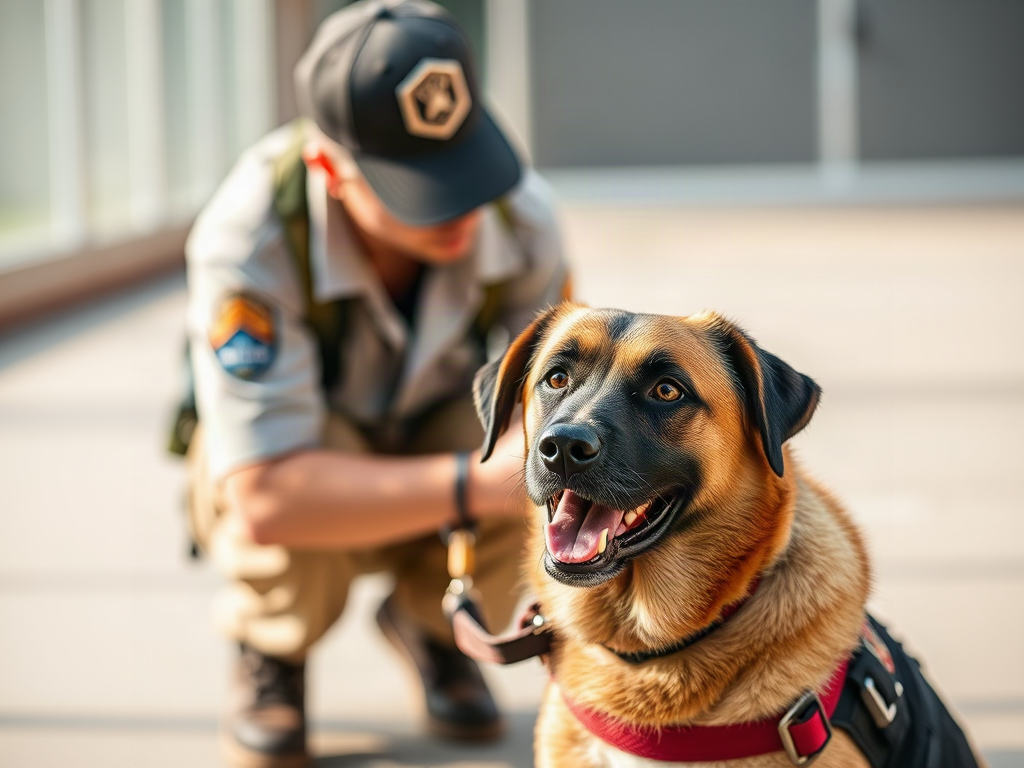
Service dog training considerations for veterans with severe hypervigilance center on reducing startling, preventing unwanted public-interruption behaviors, and building reliable tasks without forcing exposure too quickly. Training should begin in predictable, low-stimulation settings, use carefully chosen alert or grounding tasks, and progress only when the veteran and dog can remain within a manageable arousal range. A dog that crowds, barks, pulls toward perceived threats, or reacts unpredictably may increase scanning and avoidance rather than provide support. Veteran-specific planning should include trigger mapping, handler consent, recovery pauses, public-access readiness, veterinary oversight, and coordination with a qualified mental health professional and experienced service-dog trainer.
Why Hypervigilance Changes the Training Equation
Severe hypervigilance can make ordinary service-dog training feel unsafe because the handler may monitor doors, people, sounds, exits, and the dog at the same time. A sudden leash movement or unexpected bark can become additional sensory information to interpret. Training therefore has to account for the veteran’s nervous-system load, not merely the dog’s obedience. The immediate objective is a predictable partnership in which the dog’s behavior remains clear during rising tension.
A trainer may see a dog that is attentive and energetic, while the veteran experiences that same attention as intrusive or activating. Close contact, repeated nudging, or a dog that continually looks toward strangers can unintentionally keep threat monitoring active. For example, a dog trained to notice every person approaching from behind may appear vigilant but could encourage the handler to search for danger more often. A quieter behavior, such as orienting to the handler and settling at the feet, may be more useful in crowded settings.
Training environments should begin with controllable variables: familiar rooms, limited observers, consistent equipment, and a clear exit. The veteran should know what behavior is being practiced, how long the session will last, and what signal ends the exercise. A short session that finishes before overload is usually more informative than a long session that ends with the dog and handler both dysregulated. This is not avoidance of all challenge; it is deliberate control of challenge so learning remains possible.
Common failure points include treating hypervigilance as simple disobedience, introducing public distractions before the dog has a dependable settle, and assuming the veteran must tolerate discomfort to prove readiness. A qualified team can instead record observable indicators such as faster scanning, gripping the leash, repeated checking of exits, breath-holding, or difficulty responding to the dog’s cues. Those observations help determine whether to reduce distance, shorten the session, change the task, or stop for recovery.
Veterans researching service dog training considerations for veterans with severe hypervigilance should prioritize behavioral predictability over impressive demonstrations. A dog that performs fewer tasks calmly may be a safer match than a highly driven dog that learns quickly but remains sensitive to movement, noise, or unfamiliar handling.
Selecting Tasks Without Reinforcing Threat Scanning
Task selection should address functional problems caused by the veteran’s symptoms rather than convert the dog into a threat-detection system. A service dog may be trained to interrupt a repetitive monitoring behavior, create space during a crowded encounter, provide tactile grounding, retrieve an item, or guide the handler toward a planned exit. The task must have a clear beginning and end, and the handler should be able to accept or decline it without a struggle.
Grounding tasks illustrate the necessary tradeoff. A dog placing its chin on the handler’s leg or applying trained pressure may help redirect attention toward present sensory information. Yet constant contact may be uncomfortable for a veteran who is easily startled by touch. A trainer might compare a stationary chin rest with a brief nose touch followed by a settle. The better option is the one the handler can recognize, tolerate, and use consistently, not the one that looks most dramatic during a demonstration.
Interruption requires particular care. If the dog responds every time the veteran looks toward a doorway, the behavior may reward or intensify checking rather than reduce it. Trainers should define the target precisely. A dog might interrupt repeated pacing after a measurable pattern, then guide the handler to a preselected grounding routine. It should not independently decide that every glance, stiff posture, or alert expression signals danger. Human judgment and professional assessment remain necessary when symptoms are severe.
Useful task planning asks four questions:
- What observable behavior or daily limitation is the task meant to address?
- Can the veteran recognize the dog’s cue without adding more surveillance?
- What happens if the task occurs at the wrong time?
- What backup response is available if the dog is tired, ill, distracted, or absent?
For instance, a dog trained to position beside the handler in a line may offer physical orientation and personal space, but it cannot guarantee that strangers will remain at a distance. A veteran should still have a verbal boundary, an exit plan, and support from a clinician when those situations are clinically significant. The dog is a trained aid, not a security device, sentry, or substitute for treatment.
It is also useful to distinguish a trained response from an instinctive reaction. A dog that growls at a person behind the handler is not necessarily detecting a threat; it may be reacting to novelty, fear, or inadequate socialization. Rewarding that reaction can create a public-safety problem and increase the veteran’s belief that danger is everywhere. Calm orientation, disengagement, and handler-directed movement are safer training targets.
Building Predictability, Recovery, and Public Safety
Predictability comes from consistent cues, reliable reinforcement, and gradual exposure to the specific conditions the team expects to encounter. The dog should learn where to walk, when to settle, how to ignore environmental movement, and how to respond when the handler needs distance. The veteran should learn the same dog’s early stress signals, because panting, freezing, lip-licking, scanning, or sudden pulling can indicate that the dog is no longer ready to perform.
A practical progression might move from a quiet home exercise to a familiar private training space, then to a low-traffic public location, and later to more complex environments. Each stage should test one meaningful change rather than several at once. Increasing noise, crowd density, duration, and proximity to strangers on the same day makes it difficult to identify the cause of failure. If the dog settles in a quiet store but becomes rigid near automatic doors, the next session can isolate door sounds rather than add a busy checkout line.
Recovery is part of the training behavior. After a startle, the team should have a rehearsed response: create distance, use a familiar cue, allow the dog to settle, and give the veteran time to regain orientation. Repeatedly pushing forward after either partner has lost responsiveness may produce apparent compliance while weakening trust. A dog that can return to a relaxed posture after a disruption is often more useful than one that performs brilliantly until a single unexpected event causes prolonged agitation.
Equipment can either clarify or complicate communication. A comfortable, well-fitted harness or leash may give the handler stable control, but equipment should not be used to overpower a frightened dog or restrain behavior that has not been properly trained. The veteran should practice handling in clothing and settings that resemble daily life. A dog that responds only when a trainer holds the leash may not be ready for independent work.
Common mistakes include taking the dog into crowded places to “get used to it,” allowing strangers to pet or question the dog, and overlooking the veteran’s need for an immediate exit. Public access should be earned through stable behavior, not treated as a test of courage. A compact readiness check can include:
- The dog settles without repeated corrections.
- The handler can identify early stress in both partners.
- Known cues work around moderate distractions.
- The team can leave without rushing, conflict, or unsafe leash behavior.
- The task helps the handler function rather than prompting more threat interpretation.
Those standards do not guarantee success in every environment. They provide evidence that the team has enough control to make a cautious decision about the next setting. Readers comparing service dog training considerations for veterans with severe hypervigilance should treat recovery speed and handler confidence as meaningful data alongside task accuracy.
Evaluating Progress and Choosing Professional Support
Progress should be measured by function, not by how much discomfort the veteran can endure. A useful record might note the setting, trigger intensity, dog behavior, handler response, task outcome, recovery time, and whether the team needed assistance. Improvement may look like completing a short appointment with fewer exit checks, recovering sooner after a loud noise, or using a grounding task before escalation. These are more informative than a vague judgment that training felt good or bad.
Professional support should include a trainer experienced with service-dog task work and behavior in public environments, plus a mental health professional familiar with trauma-related symptoms. The roles differ. The trainer evaluates learning, handling, canine temperament, and public behavior; the clinician helps assess symptom patterns, treatment compatibility, and whether a particular task could reinforce avoidance or fear. Neither professional should promise that a dog will eliminate hypervigilance.
Temperament screening deserves as much attention as trainability. A dog may be intelligent and affectionate yet unsuitable for a veteran who is sensitive to sudden movement, vocalization, or close body contact. The prospective handler should observe the dog around controlled sounds, mobility changes, unfamiliar people, and pauses in activity. A trainer should explain what the dog does when uncertain, how quickly it returns to baseline, and whether its responses are manageable without harsh correction.
Funding, housing, transportation, and daily care also affect the decision. Veterinary costs, exercise needs, grooming, food, and backup care continue even when symptoms flare. If handling a dog during a severe episode is unrealistic, the support plan should identify another responsible person or a lower-demand alternative. A service dog can add structure, but the structure becomes a burden if the veteran has no reliable way to meet the animal’s needs.
Warning signs of a poor training arrangement include pressure to accept a dog before a stable match is demonstrated, punishment for fear-related behavior, unclear task definitions, no plan for public incidents, and claims that the dog can detect danger or replace clinical care. A stronger program welcomes questions, documents goals, adjusts the pace, and lets the veteran decline a task that feels activating or impractical.
The next decision should be specific: identify one or two daily limitations, discuss them with a clinician, obtain an honest temperament assessment, and arrange a low-stimulation evaluation with a qualified trainer. That process is more defensible than choosing a dog based on breed image, emotional attachment, or a promise of rapid transformation.
Frequently Asked Questions
Should a service dog be trained to detect threats?
No. Threat detection can encourage scanning or produce unreliable reactions. Calm orientation, interruption of defined behaviors, grounding, and handler-directed movement are generally safer targets.
Can severe hypervigilance make public-access training unsafe?
It can raise risk if the dog or handler becomes reactive, overwhelmed, or unable to exit calmly. Training should begin in controlled settings and advance only when recovery and cue response are dependable.
What task might help during escalating hypervigilance?
Depending on the person, a trained tactile interruption, chin rest, grounding contact, or guided movement to a planned exit may be useful. A clinician and qualified trainer should help select and test the task.
What dog behavior should concern a prospective handler?
Persistent barking, lunging, freezing, pulling toward strangers, slow recovery after noise, or inability to settle should prompt a careful reassessment of the match and training plan.
Can a service dog replace PTSD treatment?
No. A service dog may support daily functioning for some veterans, but it should complement—not replace—professional mental health care and an individualized safety plan.
Conclusion
A workable service-dog partnership for a veteran with severe hypervigilance depends on predictability, carefully defined tasks, and the ability of both partners to recover after disruption. The strongest plan avoids training the dog as a guard and instead develops calm interruption, grounding, settling, and handler-directed movement. Temperament matters as much as intelligence, while public access should follow demonstrated stability rather than pressure to endure crowded environments. Before committing, identify the daily problem the dog is meant to address, review that goal with a mental health professional, and arrange an evaluation with an experienced service-dog trainer. Keep a backup plan for days when symptoms, illness, or practical demands make handling difficult. A cautious match and measurable progress provide a sounder foundation than promises of instant relief.