
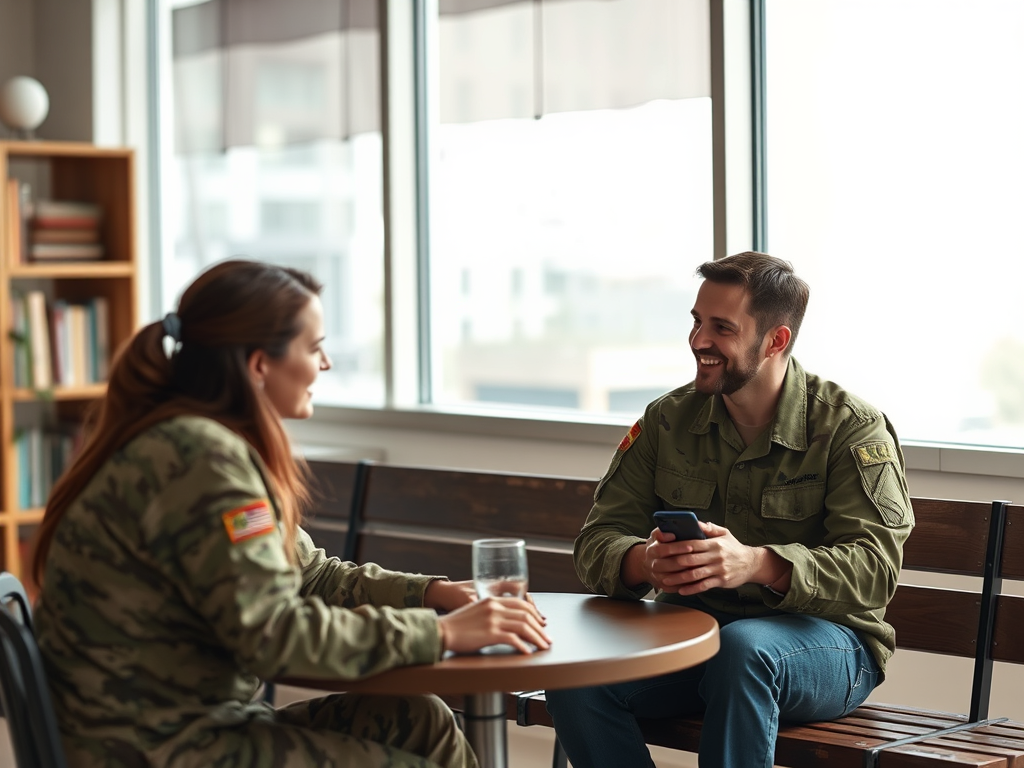
PTSD and difficulty making friends after military service often develop when hypervigilance, mistrust, emotional numbness, and discomfort with unfamiliar social settings make ordinary conversations feel unsafe or exhausting. A practical response is to begin with predictable, low-pressure contact, choose people who respect clear boundaries, and increase social time gradually rather than forcing crowded gatherings. Trauma-focused treatment can address avoidance and threat responses, while peer groups may provide shared military context without requiring immediate personal disclosure. Watch for worsening isolation, substance use, anger, or thoughts of self-harm; those signs warrant prompt professional support through a clinician, VA care, or the 988 Suicide & Crisis Lifeline.
Why Social Connection Feels Different After Service
Difficulty making friends after military service is not necessarily a sign of poor social skills or a lack of interest in people. PTSD can alter the way a person evaluates safety, trust, attention, and emotional closeness. A crowded restaurant may create constant scanning for exits and sudden movements. A casual question about deployment may feel intrusive. Even a friendly invitation can trigger the expectation that accepting it will lead to pressure, judgment, or loss of control.
Military life can also provide a strong social structure: shared routines, clear roles, common language, and reliance under demanding conditions. Leaving that environment removes built-in contact while PTSD may make civilian interactions feel less predictable. The result can be a difficult combination: wanting companionship but avoiding the very situations where friendship could develop.
Emotional numbing creates a different barrier. Someone may attend a gathering yet feel detached, unable to enjoy conversation, or unsure how much emotion to show. Irritability and sleep problems can further reduce patience. A person who cancels twice may conclude that friendship is impossible, while a potential friend may simply assume there is no interest.
A useful distinction is between preference and avoidance. Choosing a quiet coffee with one person because large groups are tiring is a reasonable preference. Refusing every invitation because anxiety predicts humiliation or danger is more consistent with avoidance. The difference matters because avoidance usually provides short-term relief but leaves fear untested and isolation stronger.
For instance, a former service member might feel comfortable talking with another veteran about equipment or duty but freeze when a civilian asks about hobbies. The solution is not to force disclosure. It is to identify the specific pressure point—unfamiliarity, personal questions, noise, mistrust, or fear of anger—and select a social setting that reduces that pressure.
Choosing Friendships That Feel Manageable and Safe
The best first friendship target is usually not the most socially impressive person or the largest group. It is someone whose behavior is consistent, respectful, and compatible with the veteran’s current capacity. Predictability gives the nervous system fewer surprises to manage. A quiet neighbor, coworker, former service member, or regular at a shared activity may be a better starting point than an expansive social club.
Shared interests can create conversation without demanding immediate vulnerability. Walking, woodworking, fishing, gaming, fitness, volunteering, or attending a structured class gives people something to do while they learn about one another. Activity-based contact can be easier than face-to-face conversation because silence does not automatically feel like failure.
Military peer connection has real value, but it is not automatically safe or healthy. Shared experience can reduce the need to explain certain reactions, yet some groups may normalize heavy drinking, aggressive humor, or avoidance of treatment. A civilian friendship may offer a broader connection to post-service life, but differences in background can produce misunderstandings. Neither option is universally better; the relevant question is whether the relationship supports stability, respect, and honest boundaries.
Early warning signs deserve attention. A potential friend who mocks therapy, ignores a request for space, pressures someone to drink, or treats trauma details as entertainment is a poor match. Conversely, a suitable person does not need a complete history. They can accept statements such as “I do better with advance notice” or “I am not ready to discuss that” without demanding an explanation.
Use the same careful approach when considering ptsd and difficulty making friends after military service in relation to family or workplace relationships. Friendship is not measured by instant closeness. A low-pressure contact who respects limits may provide more reliable progress than an intense bond that quickly becomes overwhelming.
A Gradual Method for Rebuilding Social Contact
Rebuilding a social life works better as a graded process than as a sudden demand to “get out more.” The first task is to choose a situation that is challenging but tolerable. A ten-minute conversation after a recurring activity may be more useful than attending a loud party for two hours and leaving distressed. The goal is repeated, manageable contact that allows new experiences to compete with PTSD’s predictions.
A practical sequence might look like this:
- Contact: Send a short message or make a brief comment to someone familiar.
- Structure: Suggest a specific activity with a clear beginning and end, such as coffee for thirty minutes or a walk around a local park.
- Boundary: Decide in advance what topics, locations, and duration feel acceptable.
- Review: Afterward, note what actually happened, what triggered distress, and what made the interaction easier.
Specific invitations reduce uncertainty. “Want to hang out sometime?” requires both people to solve the logistics. “Would you like coffee Saturday at 10 at the library café?” creates a defined choice and an easy exit. If the invitation is declined, avoid treating the answer as proof of rejection; scheduling conflicts are common, and one response does not define the relationship.
Preparation should support participation, not become another ritual. Checking the venue, planning transportation, and choosing a seat near an exit may be reasonable. Repeatedly inspecting every detail, rehearsing every sentence, or canceling unless conditions are perfect can strengthen avoidance. A clinician trained in PTSD treatment can help distinguish useful preparation from safety behaviors that keep fear in place.
Signs of progress include staying in a conversation slightly longer, recovering more quickly after an awkward moment, or sending a follow-up message without prolonged rumination. Signs the step is too large include panic that remains intense for hours, repeated dissociation, escalating substance use, or several days of severe sleep disruption. Scale down the demand rather than abandoning connection entirely.
Treatment, Boundaries, and Signs You Need More Support
Social difficulty may improve when PTSD itself receives appropriate care. Evidence-based PTSD treatments can address intrusive memories, avoidance, threat sensitivity, and beliefs about trust or danger. Treatment choices depend on symptoms, history, access, and personal preference; a primary-care clinician, mental-health professional, or VA provider can discuss suitable options. Friendship-building is not a replacement for treatment when symptoms are severe.
Therapy can also provide a controlled place to practice communication. A person might rehearse how to decline an invitation, explain a need for quiet, or repair a tense exchange without revealing combat details. Couples or family support may be useful when withdrawal is affecting a household. Peer support can complement clinical care, particularly when shared service experience reduces shame, but peers should not be expected to manage crisis symptoms alone.
Boundaries protect both connection and recovery. Helpful boundaries are concrete: no surprise visits, no alcohol-centered outings, permission to leave early, and no discussion of specific experiences. They should be communicated before resentment builds. A friend may accept a limit more readily when given an alternative: “I cannot attend the bar, but I can meet for breakfast.”
Common mistakes include testing a new friend with personal disclosures, interpreting ordinary disappointment as betrayal, and using alcohol to suppress social anxiety. Rapid disclosure can create closeness before trust has been established, while alcohol may worsen sleep, irritability, medication risks, and trauma symptoms. A slower relationship may feel less dramatic but is often easier to evaluate.
Seek prompt support if isolation is accompanied by hopelessness, suicidal thoughts, threats, uncontrolled anger, dangerous substance use, or inability to function. In the United States, call or text 988 for the Suicide & Crisis Lifeline; veterans can press 1. For immediate danger, call emergency services. Readers seeking related context can also review ptsd and difficulty making friends after military service alongside guidance on treatment and veteran support.
Frequently Asked Questions
Can PTSD make it hard to trust new friends?
Yes. Hypervigilance, past betrayal, emotional numbing, and fear of judgment can make ordinary uncertainty feel threatening. Trust usually develops through repeated, respectful behavior rather than instant disclosure.
Should a veteran only socialize with other veterans?
No. Veteran peers may understand service experiences, while civilian friends can support broader community connection. Choose relationships based on respect, stability, shared interests, and willingness to honor boundaries.
What is a manageable first step toward friendship?
Choose one familiar person and propose a short, specific activity in a predictable setting. A time-limited coffee or walk is usually easier to manage than an unstructured party.
Is avoiding social events always a PTSD symptom?
No. People may reasonably prefer quiet settings or need recovery time. Avoidance becomes more concerning when fear controls decisions, causes distress, and steadily removes valued relationships or activities.
When should someone seek professional help?
Seek help when isolation, nightmares, panic, anger, substance use, or depressed mood interferes with daily life or relationships. Suicidal thoughts or immediate danger require urgent crisis support.
Conclusion
Friendship after military service may need to be rebuilt around predictability, boundaries, and repeated low-pressure contact. Start by identifying the setting that creates the least strain, then choose a person whose actions show patience and respect. Shared veteran experience can help, but it should not excuse drinking pressure, hostility, or disregard for limits. Track practical signs of progress, such as recovering faster after conversations and tolerating modest uncertainty, rather than expecting instant closeness. If avoidance is driven by intrusive memories, hypervigilance, numbness, or severe anxiety, PTSD treatment deserves priority alongside social practice. A clinician, VA provider, trusted peer program, or crisis service can provide support when isolation becomes unsafe or unmanageable.