
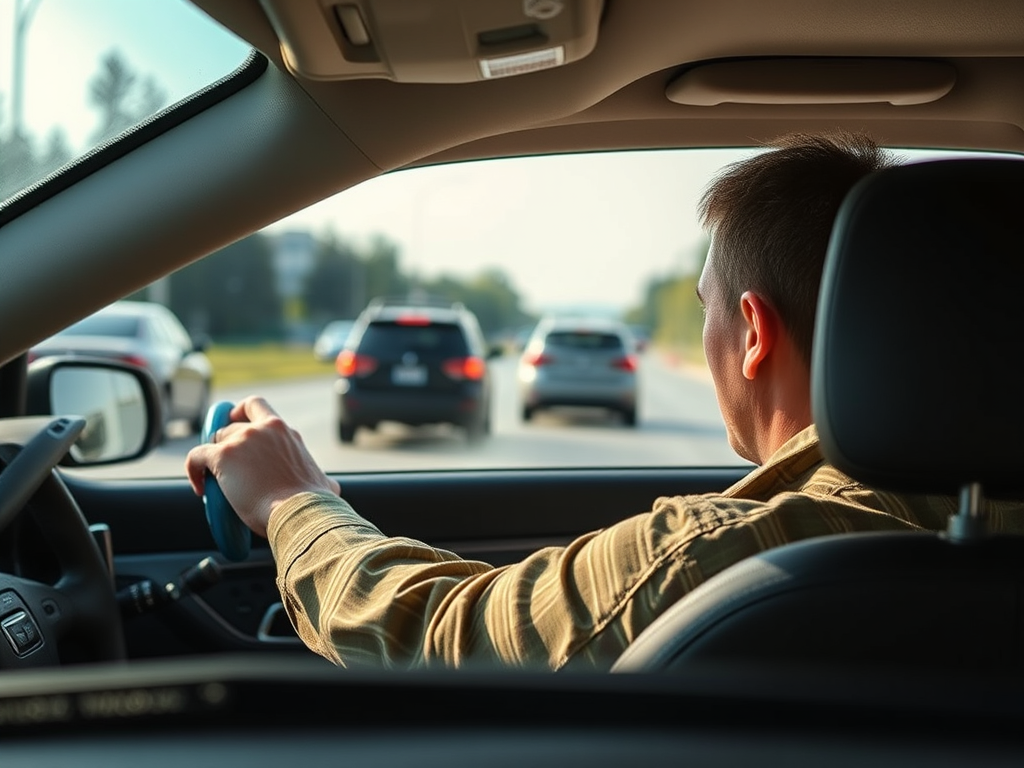
Hypervigilance makes driving difficult after military trauma because the brain may treat ordinary traffic cues—sudden braking, vehicles approaching from behind, roadside objects, or crowded intersections—as possible threats. That heightened scanning can narrow attention, increase muscle tension, speed up decisions, and trigger avoidance, panic, irritability, or dissociation. Driving may become especially taxing when fatigue, darkness, congestion, unfamiliar routes, or loud noises add sensory load. Safer progress usually involves identifying personal triggers, reducing unnecessary driving demands, practicing regulated breathing while parked, and working with a qualified trauma clinician on gradual exposure rather than forcing long or stressful trips.
How Hypervigilance Changes the Driving Task
Driving requires selective attention: a person must monitor mirrors, lane position, speed, signs, pedestrians, and changing traffic while ignoring information that does not affect the immediate maneuver. Hypervigilance after military trauma can disrupt that filtering process. The nervous system remains prepared for danger, so a harmless movement may receive the same urgent attention as a genuine road hazard.
That shift can produce several practical effects. A driver may check mirrors repeatedly, scan rooftops or roadside areas, grip the steering wheel tightly, or brake abruptly when a vehicle changes lanes. Attention can move so rapidly among perceived threats that the driver misses a turn, loses track of a pedestrian, or struggles to judge following distance. Some people experience a racing heart and narrowed visual focus; others feel detached, mentally foggy, or unable to process information quickly.
A combat-related threat environment is also different from civilian traffic. Military training may have required constant observation of sectors, unusual sounds, concealed positions, or rapid changes in terrain. Those skills were adaptive in that setting, but applying the same level of surveillance to every parked car or roadside barrier can overload the mind during a routine commute. The issue is not a lack of discipline or driving ability. It is a mismatch between a threat-detection system and a comparatively predictable environment.
For example, a driver might see a truck stopped on a shoulder and immediately focus on what could be hidden behind it. During those seconds, the vehicle may drift toward the lane line. A less useful response is to criticize the reaction or force continued driving. A more useful response is to notice the attention shift, create distance, and pull over if concentration does not return. The reasons driving becomes difficult after military trauma are best evaluated through specific driving patterns rather than a general judgment about confidence.
Triggers That Make Ordinary Traffic Feel Threatening
Hypervigilance is often intensified by sensory and situational triggers rather than by driving itself. Sudden horns, motorcycles passing close by, heavy vehicles behind the car, construction barriers, bridges, dark roads, and dense intersections can all resemble elements of prior danger. A driver may understand intellectually that a situation is safe while the body reacts as if immediate action is required.
Control and predictability also matter. A familiar route with clear visibility may feel manageable, while an unfamiliar route demands simultaneous navigation, traffic monitoring, and threat scanning. Congestion removes escape options and reduces following distance, which can increase the sense of being trapped. Night driving may add glare, limited visibility, and fewer visual details. Fatigue matters because it makes it harder to distinguish a relevant hazard from a trauma-linked alarm.
Common reactions include avoiding highways, staying in the right lane at unusually low speeds, taking long detours, refusing to drive with passengers, or repeatedly checking the back seat. Avoidance can provide immediate relief, but it may gradually shrink the person’s usable travel range. At the other extreme, forcing a difficult trip without preparation can reinforce the belief that driving is uncontrollable. Neither total avoidance nor reckless endurance is a reliable measure of progress.
A short driving log can reveal patterns without turning every trip into a test. Record the route, time of day, traffic density, trigger, body reaction, driving behavior, and recovery time. A useful distinction is whether the main problem is fear, anger, sensory overload, dissociation, or a specific memory cue. For instance, a person who becomes disoriented after a loud bang needs a different plan from someone who remains oriented but repeatedly scans behind the vehicle. Identifying the trigger makes the next adjustment more precise.
What Safer Driving Practice Looks Like
Safer practice begins with reducing avoidable demands while preserving ordinary independence where possible. The goal is not to eliminate every uncomfortable sensation before driving. The goal is to keep attention available for road decisions and to recognize early signs that a break is needed.
Before a trip, choose a route with fewer complicated merges, allow extra time, adjust mirrors and seating, and avoid beginning with the most crowded or unfamiliar journey. A navigation device can reduce route-related workload, but entering directions while moving creates a new hazard. Set the route while parked, silence nonessential alerts, and keep the cabin arranged so that loose objects do not create sudden noise. A trusted passenger may help if that person understands not to give rapid instructions or repeatedly ask whether the driver is all right.
When alarm rises, a brief regulation method may be more practical than trying to reason away the reaction. While stopped safely, place both feet on the floor, identify the current location and destination, and use a slow exhale without holding the breath. The purpose is to restore orientation and reduce urgency, not to guarantee immediate calm. If the driver is losing track of lanes, feeling unreal, experiencing severe panic, or becoming too angry to make measured decisions, pulling over is the responsible choice.
A compact pre-drive checklist can include:
- Am I rested enough to monitor traffic and make decisions?
- Which route has the fewest predictable triggers today?
- Where could I stop safely if concentration drops?
- Have navigation, phone, mirrors, and seat settings been handled before moving?
- What early sign tells me to reduce demands or end the trip?
Gradual practice is usually more informative than a single high-stress test. Someone who avoids highways might first ride as a passenger on a quiet segment, then drive a short familiar portion during low traffic, and later add one controlled challenge. Repeating a manageable route can build evidence that discomfort can rise and fall without an emergency. The tradeoff is that progress may feel slow, and a route that works one day may not work after poor sleep or a difficult anniversary. Flexibility is safer than treating a planned exposure as a requirement.
When Treatment and Professional Support Matter
Driving difficulty deserves clinical attention when it causes repeated near-misses, panic, dissociation, severe avoidance, aggressive reactions, or major disruption to work and family responsibilities. A qualified mental health professional can assess whether trauma symptoms, sleep problems, depression, medication effects, substance use, vestibular concerns, or another condition is contributing. Hypervigilance should not be assumed to be the only explanation for every concentration problem.
Trauma-focused care may help a person understand why civilian traffic cues activate military threat responses and develop skills for responding without automatically obeying the alarm. Exposure-based work should be individualized and paced. A clinician may help establish a hierarchy ranging from sitting in a parked car to taking a short route, but the sequence should account for dissociation, physical symptoms, driving history, and current safety. Exposure is not a contest, and flooding someone with a situation that feels unmanageable can strengthen avoidance.
Practical coordination may also be necessary. An occupational therapist, driving rehabilitation specialist, or qualified instructor may help evaluate attention, route demands, vehicle setup, and specific driving behaviors. This can be especially useful when the person wants an objective assessment rather than relying solely on fear. A clinician can also review whether medication causes drowsiness or slowed reaction time; medication should not be started, stopped, or changed without the prescriber’s guidance.
Support from family members has limits. A passenger who says “just relax” may unintentionally increase shame, while someone who calmly agrees on stopping locations and avoids distracting conversation can reduce pressure. The driving difficulties linked to hypervigilance become more manageable when everyone treats safety decisions as planned procedures rather than proof of weakness.
Signs that a plan is working include earlier recognition of activation, fewer abrupt driving responses, quicker recovery after a trigger, and the ability to choose a safe stop before judgment deteriorates. Signs that the plan needs revision include escalating avoidance, repeated unsafe maneuvers, worsening dissociation, or distress that remains high long after the trip. Those patterns call for a clinical review, not simply more exposure.
Frequently Asked Questions
Can hypervigilance make a person unsafe to drive?
It can affect driving safety when scanning, panic, anger, or dissociation interferes with lane control, hazard recognition, or judgment. A person should stop driving and seek professional guidance if those effects are recurring.
Why do highways often feel harder after military trauma?
Highways combine speed, limited escape options, close following distances, frequent merges, and vehicles approaching from behind. Those conditions can increase perceived threat and reduce the time available to regain focus.
Should someone avoid driving until hypervigilance disappears?
Not necessarily. Total avoidance may expand fear, while forcing difficult trips may create unsafe overload. A clinician-supported progression using manageable routes is often more appropriate.
What should a driver do after a sudden trauma reaction?
Signal, move to a safe stopping place when possible, and pause until orientation and concentration return. Do not continue simply to complete the trip if lane control or judgment feels unreliable.
Can a passenger make driving easier?
Yes, if the passenger reduces distraction, avoids sudden criticism, and agrees in advance on calm stopping procedures. A passenger who gives rapid directions or monitors every movement may increase the driver’s workload.
Conclusion
Hypervigilance changes driving by keeping attention fixed on possible danger, even when traffic conditions are ordinary. The most useful response is neither shame nor forced endurance. Identify the situations that raise activation, reduce unnecessary route demands, prepare safe stopping options, and treat loss of concentration or orientation as a clear reason to pause. A driving log can show whether darkness, congestion, noise, unfamiliar roads, or fatigue is carrying the greatest load. When reactions include dissociation, near-misses, severe avoidance, or intense anger, a trauma-informed clinician should help shape the next step. Gradual practice may be appropriate for some people, but it should remain paced, safety-focused, and adaptable to changing symptoms. The connection between military trauma and driving difficulty becomes clearer when symptoms are measured by their effect on real decisions, not by how well someone appears to cope.